
Showing posts with label Sukkot. Show all posts
Showing posts with label Sukkot. Show all posts
Tuesday, October 14, 2014

Saturday, September 21, 2013
Sukkot
After the intensity, heightened spirituality and inward reflection of the High Holidays -- the "Days of Awe" from Rosh Hashana to Yom Kippur -- Sukkot is a time of fragility, of connection to nature and family. Instead of congregating en masse in the great edifices of our communal sanctuaries, we build temporary structures barely big enough for a simple table and chairs, covered with a few symbolic branches for a roof over our heads.
It is a holiday for hospitality. The sukkah is intended to be always open for guests. We symbolically invite the Biblical patriarchs and prophets to join us, and the Lulav (Four Species) represents the full spectrum of people whom we should welcome to join us.
On Shabbat Sukkot, we read the book of Ecclesiastes -- a lyrical exposition on the fragility of life itself. As our rabbi said this morning, during the Days of Awe it seems that it is all about us: our sins, our repentance. On Sukkot we find that it is not all about us at all.
On Rosh Hashana and Yom Kippur we hear the mighty blasts of the Shofar. On Sukkot we just hear the rustling of the leaves. And it is enough.

It is a holiday for hospitality. The sukkah is intended to be always open for guests. We symbolically invite the Biblical patriarchs and prophets to join us, and the Lulav (Four Species) represents the full spectrum of people whom we should welcome to join us.
On Shabbat Sukkot, we read the book of Ecclesiastes -- a lyrical exposition on the fragility of life itself. As our rabbi said this morning, during the Days of Awe it seems that it is all about us: our sins, our repentance. On Sukkot we find that it is not all about us at all.
On Rosh Hashana and Yom Kippur we hear the mighty blasts of the Shofar. On Sukkot we just hear the rustling of the leaves. And it is enough.

Sunday, September 30, 2012
Sukkot and Special Needs
We have just completed the cathartic process of atonement, which some say began at the beginning of the month of Elul (a month before Rosh Hashanah), and some even begin earlier, on Tish'a B'Av. According to the Jewish calendar, the next holiday is already upon us just 4 days later. This is the fall harvest holiday, Sukkot (Feast of Tabernacles). Quickly, we must put up the transient shelter symbolizing the tents of the Hebrews during the Exodus. We collect branches for the ephemeral roof, and coach our children in the making of paper chains for decoration.
We make do with the barest of shelters, and we celebrate the abundance of divine provision.
We build a tiny hut, and we invite guests to join us and crowd in every day for a week.
What an appropriate metaphor for recognizing the value in every individual, no matter how inadequate they seem! Here is this grossly deficient structure, which utterly fails to protect us from the elements, and we choose it specifically to celebrate, not only with our own family, but to share with others, flaunting it, glorifying in it! The Sukkah has a value beyond its exterior form. So, too, we are challenged to see people with disabilities, not by the external limitations of their physical form, but by the spiritual meaning of their humanity.
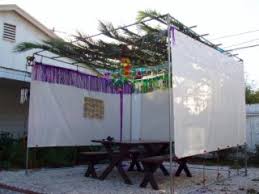
Just in case we fail to take in this message, tradition hits us over the head with it.
One of the main observances of the holiday is the taking of "The 4 Species" a.k.a. "Lulav and Etrog". These are a citron, a date palm frond, a willow twig and a myrtle bough.
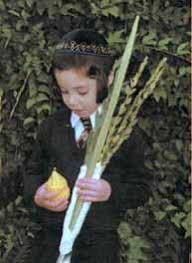
They are held together and shaken up, down, and to the 4 compass points, demonstrating the everpresence of G*d. There are many interpretations of the symbolism of these plants, but the most common is this:
Chag Same'ach! (Happy holiday!)
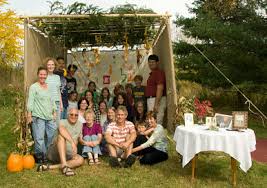
We make do with the barest of shelters, and we celebrate the abundance of divine provision.
We build a tiny hut, and we invite guests to join us and crowd in every day for a week.
What an appropriate metaphor for recognizing the value in every individual, no matter how inadequate they seem! Here is this grossly deficient structure, which utterly fails to protect us from the elements, and we choose it specifically to celebrate, not only with our own family, but to share with others, flaunting it, glorifying in it! The Sukkah has a value beyond its exterior form. So, too, we are challenged to see people with disabilities, not by the external limitations of their physical form, but by the spiritual meaning of their humanity.
Just in case we fail to take in this message, tradition hits us over the head with it.
One of the main observances of the holiday is the taking of "The 4 Species" a.k.a. "Lulav and Etrog". These are a citron, a date palm frond, a willow twig and a myrtle bough.
They are held together and shaken up, down, and to the 4 compass points, demonstrating the everpresence of G*d. There are many interpretations of the symbolism of these plants, but the most common is this:
Perhaps the best known is that there are four types of Jews: the etrog, which possesses both taste and fragrance symbolizes those who possess both learning and good deeds. The palm branches possess taste but no fragrance, symbolizing those who possess learning but do not perform good deeds. The myrtle is the inverse of the palm, possessing no taste but having a pleasant fragrance; this is likened to those who are not learned but do good deeds. Finally, the willow has neither taste nor fragrance, symbolizing those who possess neither learning nor good deeds. We, of course, wish to be the etrog, possessing both learning and good deeds. But the reality of life is that our communities are made of all four types of people and because community is such a high priority in Judaism, we bind all four species together, as we ought to bring together all Jews in one community.In other words, the worth of a person is not defined by their intellectual ability (learning) nor by their physical ability (good deeds). We are commanded to bring all people in our community together, in our frail symbol of abundance, and point to all directions, showing that our relationship to G*d is not limited by the external manifestation of our physical bodies or material circumstances.
Chag Same'ach! (Happy holiday!)
Subscribe to:
Comments (Atom)