I realized in retrospect, that the metaphor of the burning building is not exactly the way I feel about special needs adoption, and I was reminded of a metaphor I thought about a month or 2 ago.
Rather than in a burning building, I see the abandoned, neglected, malnourished disabled children trapped in orphanages as drowning in a lake.
What is the difference?
Running into a burning building is dangerous, even for trained firefighters. Specialized equipment is required to insulate against the extreme heat, and there is always the risk of the structure itself falling on top of you. If special needs adoption involved that level of danger, it would make sense to say no.
However, as I learned more about the families who had blogged about their experiences, I realized that this is not anything like a burning building! Most people can swim reasonably well. Most people can swim even while carrying a small child. Swimming does not take specialized equipment or extensive training. Most people don't want to jump in a cold lake and swim in their clothes, but would do so - and deal with the slight discomfort - if the life of a child depended on it. Some people cannot swim, and some people may have conditions which make swimming under those conditions a really bad idea. But for most people, that is not the case. Everything else in my previous post would still apply: Someone needs to call 9-1-1. Some people need to bring warm blankets and perform CPR on the rescued children. But we don't really need to wait for a team of Olympic swimmers or lifeguards to jump in and do the rescuing. Some of the drowning children are "heavier" and need a stronger swimmer to come out for them. But most are not. They just need someone to put their own discomfort aside and take the plunge.
Sunday, September 30, 2012

Sukkot and Special Needs
We have just completed the cathartic process of atonement, which some say began at the beginning of the month of Elul (a month before Rosh Hashanah), and some even begin earlier, on Tish'a B'Av. According to the Jewish calendar, the next holiday is already upon us just 4 days later. This is the fall harvest holiday, Sukkot (Feast of Tabernacles). Quickly, we must put up the transient shelter symbolizing the tents of the Hebrews during the Exodus. We collect branches for the ephemeral roof, and coach our children in the making of paper chains for decoration.
We make do with the barest of shelters, and we celebrate the abundance of divine provision.
We build a tiny hut, and we invite guests to join us and crowd in every day for a week.
What an appropriate metaphor for recognizing the value in every individual, no matter how inadequate they seem! Here is this grossly deficient structure, which utterly fails to protect us from the elements, and we choose it specifically to celebrate, not only with our own family, but to share with others, flaunting it, glorifying in it! The Sukkah has a value beyond its exterior form. So, too, we are challenged to see people with disabilities, not by the external limitations of their physical form, but by the spiritual meaning of their humanity.
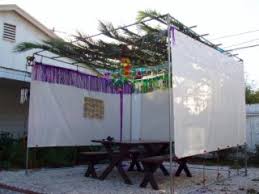
Just in case we fail to take in this message, tradition hits us over the head with it.
One of the main observances of the holiday is the taking of "The 4 Species" a.k.a. "Lulav and Etrog". These are a citron, a date palm frond, a willow twig and a myrtle bough.
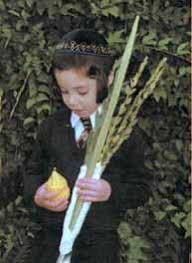
They are held together and shaken up, down, and to the 4 compass points, demonstrating the everpresence of G*d. There are many interpretations of the symbolism of these plants, but the most common is this:
Chag Same'ach! (Happy holiday!)
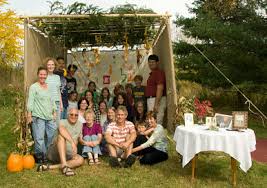
We make do with the barest of shelters, and we celebrate the abundance of divine provision.
We build a tiny hut, and we invite guests to join us and crowd in every day for a week.
What an appropriate metaphor for recognizing the value in every individual, no matter how inadequate they seem! Here is this grossly deficient structure, which utterly fails to protect us from the elements, and we choose it specifically to celebrate, not only with our own family, but to share with others, flaunting it, glorifying in it! The Sukkah has a value beyond its exterior form. So, too, we are challenged to see people with disabilities, not by the external limitations of their physical form, but by the spiritual meaning of their humanity.
Just in case we fail to take in this message, tradition hits us over the head with it.
One of the main observances of the holiday is the taking of "The 4 Species" a.k.a. "Lulav and Etrog". These are a citron, a date palm frond, a willow twig and a myrtle bough.
They are held together and shaken up, down, and to the 4 compass points, demonstrating the everpresence of G*d. There are many interpretations of the symbolism of these plants, but the most common is this:
Perhaps the best known is that there are four types of Jews: the etrog, which possesses both taste and fragrance symbolizes those who possess both learning and good deeds. The palm branches possess taste but no fragrance, symbolizing those who possess learning but do not perform good deeds. The myrtle is the inverse of the palm, possessing no taste but having a pleasant fragrance; this is likened to those who are not learned but do good deeds. Finally, the willow has neither taste nor fragrance, symbolizing those who possess neither learning nor good deeds. We, of course, wish to be the etrog, possessing both learning and good deeds. But the reality of life is that our communities are made of all four types of people and because community is such a high priority in Judaism, we bind all four species together, as we ought to bring together all Jews in one community.In other words, the worth of a person is not defined by their intellectual ability (learning) nor by their physical ability (good deeds). We are commanded to bring all people in our community together, in our frail symbol of abundance, and point to all directions, showing that our relationship to G*d is not limited by the external manifestation of our physical bodies or material circumstances.
Chag Same'ach! (Happy holiday!)
Saturday, September 29, 2012
A metaphor
I followed a link from Susanna Musser's blog today, and found this metaphor for the predicament of special-needs children trapped in institutions:
I am definitely meeting all of these attitudes as I try to make an impact in this area in my community. I think that those are normal reactions people have. A fire IS scary. Most people DON'T want to run into the blaze to rescue the children. And being concerned for one's pre-existing obligations is valid.
That's where the community project comes in. This is not about individual heroism by itself -- it is about creating an environment where the individual heroism is scaffolded by structures and supports so that these fears and concerns are abated. In fact, what do most people do in a real fire? They call 9-1-1. They bring in fire trucks to put out the fire and ambulances to provide emergency care to the children as they are brought out. They may bring jugs of water or other supplies as needed to set up emergency triage points. Somebody still needs to run in and do the rescuing, but in the context of a shared effort, not an individual act of heroism which, no matter how sincere, can act as a shaming to those who do not undertake it.
Matir Asurim will make the 911 call -- raising awareness, both of the dire conditions the children are in, and of the potential of children with special needs when they are raised in loving families with access to medical care and educational and social opportunities.
Matir Asurim will bring the fire trucks -- participating in in-country efforts to improve conditions in orphanages
Matir Asurim will bring the ambulances -- participating in charities and other organizations which bring life-saving medical care to children both in the orphanages and post-adoption
Matir Asurim will bring jugs of water -- support adopters in caring for children with special needs who are recovering from the effects of years of institutionalization. This would include both logistical and material help, as well as emotional and spiritual support.
My vision for Matir Asurim is that rather than requiring the heroic few to run in repeatedly until all are saved, whatever the cost, that more and more resources from the community will be brought in, so that saving a child is seen as a normal thing to do.
Now that is a "new normal" to aspire to!
Imagine...You are walking along a street and see that a house is on fire. There are flames pouring out every where! Hot flames...smoke pouring out of every crack and window. You get as close as you can to see if there is someone in the house - only to see the house is FULL of children. Children whose cries you cannot hear -but you just see each of their little faces as the flames are creeping closer, burning holes in their clothing and choking their every breath. You are horrified beyond your wildest nightmares. You start shouting for help to all those passing by. "Help me save these children! Help me get this one, and this one, and this one!'This blogger goes on to bemoan the lack of community support after she has gone in to save a child:
But to your amazement, people glance at you and walk away. Others say, "I am not equipped to fight fires, I am so sorry. Good luck. I support your efforts." Others wring their hands for a few moments, then say, "There are too many of them. What good will saving one do? It is only one of hundreds. Why try?" Even others say, "Why put your life at risk? Why change your day to help them? What of your own family? They are your responsibility, not these ones." One even had the nerve to say, "God wants to give you good gifts, He wants you happy - this will make your day hard. I can't imagine He would expect you to do this."
Finally, you see a few people running into the house. To your relief, these people are grabbing as many children as they can. They run them out to the arms of the rescuer's family and race back into to grab as many as they can carry.
They say that they could understand you feeling like you needed to save one -as they glance cautiously at the little one that you just risked your life for....that you were willing to GIVE your life for......but they really can't understand why you would go for another. Haven't you sacrificed enough? Some are even saying that you are selfish! They are saying that when you race into that house, it makes them uncomfortable. It distracts them from the things that they have to think about that day. You try to reason with them, but their faces are full of pity for you! Pity that you have obviously lost all common sense.
I am definitely meeting all of these attitudes as I try to make an impact in this area in my community. I think that those are normal reactions people have. A fire IS scary. Most people DON'T want to run into the blaze to rescue the children. And being concerned for one's pre-existing obligations is valid.
That's where the community project comes in. This is not about individual heroism by itself -- it is about creating an environment where the individual heroism is scaffolded by structures and supports so that these fears and concerns are abated. In fact, what do most people do in a real fire? They call 9-1-1. They bring in fire trucks to put out the fire and ambulances to provide emergency care to the children as they are brought out. They may bring jugs of water or other supplies as needed to set up emergency triage points. Somebody still needs to run in and do the rescuing, but in the context of a shared effort, not an individual act of heroism which, no matter how sincere, can act as a shaming to those who do not undertake it.
Matir Asurim will make the 911 call -- raising awareness, both of the dire conditions the children are in, and of the potential of children with special needs when they are raised in loving families with access to medical care and educational and social opportunities.
Matir Asurim will bring the fire trucks -- participating in in-country efforts to improve conditions in orphanages
Matir Asurim will bring the ambulances -- participating in charities and other organizations which bring life-saving medical care to children both in the orphanages and post-adoption
Matir Asurim will bring jugs of water -- support adopters in caring for children with special needs who are recovering from the effects of years of institutionalization. This would include both logistical and material help, as well as emotional and spiritual support.
My vision for Matir Asurim is that rather than requiring the heroic few to run in repeatedly until all are saved, whatever the cost, that more and more resources from the community will be brought in, so that saving a child is seen as a normal thing to do.
Now that is a "new normal" to aspire to!
Tuesday, September 25, 2012
At-ONE-ment
This evening begins the fast of Yom Kippur -- the Jewish Day of Atonement. For Christians, atonement is connected to identification with the sacrifice of Jesus. For Jews, atonement is a process of realignment with both G*d and our fellow man. In fact, the first step of atonement is asking forgiveness from other people whom we have hurt in the past year. Only then can we ask forgiveness of G*d for our transgressions against religious rules.
The fast will continue after this evening's services (called Kol Nidrei -- "All Vows") until tomorrow evening after the Ne'ila ("Locking") service. During this time, the Shofar (ram's horn) will be sounded numerous times. What does all this mean? How does all this fasting and praying achieve atonement for failing to keep ritual or ethical commandments?
Atonement is a process of identification or alignment. We become ONE with G*d and our fellow man. When we are all hungry and praying together, we can recognize that others in the world suffer in hunger every day. We listen to the words of Isaiah, who exhorted the Jews of his time to take the meaning of the day to heart -- not merely to fast while turning a blind eye to those who are hungry due to circumstance, not choice.
We also seek to see the Oneness in both G*d and humanity. With respect to G*d, we need to see that the rules we have transgressed are there to help us live a better life, not to make our life more difficult. In this we are like children, who rebel against parental rules that aim to teach them good habits for a lifetime.
This year, let us at-ONE with the One, and with everyone.
Gmar Khatima Tova! (May you be inscribed for good in the Book of Life)
The fast will continue after this evening's services (called Kol Nidrei -- "All Vows") until tomorrow evening after the Ne'ila ("Locking") service. During this time, the Shofar (ram's horn) will be sounded numerous times. What does all this mean? How does all this fasting and praying achieve atonement for failing to keep ritual or ethical commandments?
Atonement is a process of identification or alignment. We become ONE with G*d and our fellow man. When we are all hungry and praying together, we can recognize that others in the world suffer in hunger every day. We listen to the words of Isaiah, who exhorted the Jews of his time to take the meaning of the day to heart -- not merely to fast while turning a blind eye to those who are hungry due to circumstance, not choice.
We also seek to see the Oneness in both G*d and humanity. With respect to G*d, we need to see that the rules we have transgressed are there to help us live a better life, not to make our life more difficult. In this we are like children, who rebel against parental rules that aim to teach them good habits for a lifetime.
This year, let us at-ONE with the One, and with everyone.
Gmar Khatima Tova! (May you be inscribed for good in the Book of Life)
Sunday, September 23, 2012

Brookline Day - Fun!
What a gorgeous day we had! Lots of bright sunshine, not too hot, just a bit too windy, so I had to work a little harder to set up the table.... and forgot to take a picture! I was thinking about it, and kept putting it off.
Had a great time talking with lots of people -- several people signed up, and my whole stack of flyers was used up -- I think I had 2 left over when I was done! The guy from the local Rotary Club was interested in having me come and talk to them, too. Each opportunity creates a new one!
I had a bit of interest in my tutoring services, too. Several kids attempted the puzzle that I set up on my table. Can you solve it?
My darling husband came by with the cutest, smartest little boys in the whole world and brought me lunch.
I'm exhausted!
Had a great time talking with lots of people -- several people signed up, and my whole stack of flyers was used up -- I think I had 2 left over when I was done! The guy from the local Rotary Club was interested in having me come and talk to them, too. Each opportunity creates a new one!
I had a bit of interest in my tutoring services, too. Several kids attempted the puzzle that I set up on my table. Can you solve it?
My darling husband came by with the cutest, smartest little boys in the whole world and brought me lunch.
I'm exhausted!
Thursday, September 20, 2012
Brookline Day!
This Sunday, September 23, 2012, will be Brookline Day -- an opportunity to share my enterprises with the community. I got a booth, and I will be splitting it between my private math tutoring business and the Matir Asurim initiative. I am looking forward to talking with lots of people from my town and surrounding area, maybe network for some speaking opportunities? Maybe talk with local press? Hopefully get lots of people to sign up to be involved. Definitely raise awareness! Hopefully get some new students, too! Should be a lot of fun. If you live in the Boston area, stop by and say hi! I will be in booth #44.
Subscribe to:
Comments (Atom)